
The Wii is a home video game console released by Nintendo. As a seventh-generation console, the Wii primarily competes with Microsoft's Xbox 360
and Sony's PlayStation 3. Nintendo states that its console targets a broader demographic than that of both.
As of December 31, 2008 the Wii leads the generation over the PlayStation 3 and Xbox 360 in worldwide sales.
A distinguishing feature of the console is its wireless controller, the Wii Remote, which can be used as a handheld pointing device and detect
movement in three dimensions. Another distinctive feature of the console is WiiConnect24, which enables it to receive messages and updates over
the Internet while in standby mode.
The Wii is Nintendo's fifth home console, the direct successor to the Nintendo GameCube, and able to play all official GameCube games.
Nintendo first spoke of the console at the 2004 E3 press conference and later unveiled the system at the 2005 E3.
Satoru Iwata revealed a prototype of the controller at the September 2005 Tokyo Game Show. At E3 2006, the console won the first of several awards.
By December 8, 2006, it had completed its launch in four key markets.
Wii Remote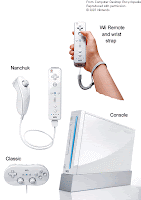
The Wii Remote is the primary controller for the console. It uses a combination of built-in accelerometers and infrared detection to sense its position
in 3D space when pointed at the LEDs within the Sensor Bar. This design allows users to control the game using physical gestures as well as traditional
button presses. The controller connects to the console using Bluetooth and features rumble as well as an internal speaker.
The Wii Remote can connect to expansion devices through a proprietary port at the base of the controller. The device bundled with the Wii retail package is
the Nunchuk unit, which features an accelerometer and a traditional analog stick with two trigger buttons.
In addition, an attachable wrist strap can be used to prevent the player from unintentionally dropping or throwing the Wii Remote.
In response to initial incidents of strap failure, Nintendo offers a free, stronger replacement for all straps.
Nintendo has also since offered the Wii Remote Jacket to provide extra grip and protection. The Wii MotionPlus was announced as a device that
connects to the Wii Remote to supplement the accelerometer and Sensor Bar capabilities and enable actions to be rendered identically on the screen in real time.
Memory storage
The Wii console contains 512 megabytes of internal flash memory and features an SD card slot for external storage.
An SD card can be used for uploading photos as well as backing up saved game data and downloaded Virtual Console and WiiWare games.
To use the SD slot for transferring game saves, an update must be installed. An installation can be initiated from the Wii options menu through an
Internet connection, or by inserting a game disc containing the updated firmware. Virtual Console data cannot be restored to any system except the unit of
origin.An SD card can also be used to create customized in-game music from stored MP3 files, as first shown in Excite Truck, as well as music for
the slideshow feature of the Photo Channel. Version 1.1 of the Photo Channel removed MP3 playback in favor of AAC support.
At the Nintendo Fall Press Conference in October 2008, Satoru Iwata announced that Wii owners would have the option to download WiiWare and Virtual
Console content directly onto an SD card. The option would offer an alternative to "address the console's insufficient memory storage".
The announcement stated that it would be available in Japan in the spring of 2009. Nintendo made the update available on March 25, 2009.
In addition to the previously announced functionalty, it lets the player load Virtual Console and WiiWare games directly from the SD card.
The update allows the use of SDHC cards, increasing the limit on SD card size from 2 GB to 32 GB.
Technical specifications
Nintendo has released few technical details regarding the Wii system, but some key facts have leaked through the press.
Though none of these reports has been officially confirmed, they generally point to the console as being an extension or advancement of the Nintendo GameCube
architecture. More specifically, the reported analyses state that the Wii is roughly 1.5 to 2 times as powerful as its predecessor.
Based on the leaked specifications, the Wii is the least powerful of the major home consoles in its generation. The Wii uses a storage system
similar to the GameCube, which uses "block" units rather than bytes. The conversion from blocks to bytes is roughly 8.12 blocks to one megabyte.
Processors:
* CPU: PowerPC-based "Broadway" processor, made with a 90 nm SOI CMOS process, reportedly† clocked at 729 MHz
* GPU: ATI "Hollywood" GPU made with a 90 nm CMOS process, reportedly† clocked at 243 MHz
Memory:
* 88 MB main memory (24 MB "internal" 1T-SRAM integrated into graphics package, 64 MB "external" GDDR3 SDRAM)
* 3 MB embedded GPU texture memory and framebuffer.
Ports and peripheral capabilities:
* Up to four Wii Remote controllers (connected wirelessly via Bluetooth)
* Nintendo GameCube controller ports (4)
* Nintendo GameCube Memory Card slots (2)
* SD memory card slot (supports SDHC cards as of System Menu 4.0)
* USB 2.0 ports (2)
* Sensor Bar power port
* Accessory port on bottom of Wii Remote
* Optional USB keyboard input in message board, Wii Shop Channel, and the Internet Channel (as of 3.0 and 3.1 firmware update)
* Mitsumi DWM-W004 WiFi 802.11b/g wireless module
* Compatible with optional USB 2.0 to Ethernet LAN adaptor
* MultiAV output port for component, composite and S-Video
Built-in content ratings systems:
* BBFC, CERO, ESRB, OFLC, OFLC (NZ), PEGI, USK
Storage:
* 512 MB built-in NAND flash memory
* Expanded storage via SD and SDHC card memory (up to 32 GB)
* Nintendo GameCube Memory Card (required for GameCube game saves)
IBM's Wii "Broadway" CPU
ATI's Wii "Hollywood" GPU
* Slot-loading disc drive compatible with 8 cm Nintendo GameCube Game Disc and 12 cm Wii Optical Disc
* Mask ROM by Macronix
Video:
* 480p (PAL/NTSC), 480i (NTSC) or 576i (PAL/SECAM), standard 4:3 and 16:9 anamorphic widescreen
* MultiAV multi-output port for component, composite, S-video,RGB SCART
Audio:
* Main: Stereo – Dolby Pro Logic II-capable
* Controller: Built-in speaker
Power consumption:
* 18 watts when switched on
* 9.6 watts in standby with WiiConnect24 standby connection
* 1.3 watts in standby
Features
The console contains a number of internal features made available from its hardware and firmware components. The hardware allows for extendibility through
expansion ports while the firmware can receive periodic updates via the WiiConnect24 service.
Wii Menu
The Wii Menu operating system interface is designed around the concept of television channels. Separate channels are graphically displayed in a grid and are
navigated using the pointer capability of the Wii Remote. It is possible to change the arrangement by holding down the A and B buttons to grab
channels and move them around. There are six primary channels: the Disc Channel, Mii Channel, Photo Channel, Wii Shop Channel, Forecast Channel,
and News Channel. The latter two were initially unavailable at launch, but activated through firmware updates.
Additional channels are available for download from the Wii Shop Channel through WiiWare and also appear with each Virtual Console title.
These include the Everybody Votes Channel, Internet Channel, Check Mii Out Channel, and the Nintendo Channel.
Backward compatibility
The Wii console is backward compatible with all official Nintendo GameCube software, as well as Nintendo GameCube Memory Cards and controllers.
Compatibility with software is achieved with the slot-loading drive's ability to accept Nintendo GameCube Game Discs.
The console supports progressive-scan output in 480p-enabled GameCube titles. Peripherals can be connected via a set of four GameCube controller
ports and two Memory Card slots concealed by removable flip-open panels.The console therefore retains connectivity with the Game Boy Advance and
e-Reader through the Game Boy Advance Cable, which is used in the same manner as it was used with the GameCube.
This feature can only be accessed on those select GameCube titles that previously utilized it. Gamercize accessories also utilize the backward compatibility
in order to support the Wii console. The Wii for release in South Korea lacks GameCube backward compatibility.
A Wii console running a GameCube disc is restricted to GameCube functionality. As such, a GameCube controller is required to play GameCube titles,
as neither the Wii Remote nor the Classic Controller functions in this capacity. A Nintendo GameCube Memory Card is also necessary to save game progress
and content, as the Wii internal flash memory will not save GameCube games.
Backward compatibility is limited in some areas. Online and LAN-enabled features for Nintendo GameCube titles are unavailable on the Wii,
as the console lacks serial ports for the Nintendo GameCube Broadband Adapter and Modem Adapter. The console uses a proprietary port for video output
and is therefore incompatible with all Nintendo GameCube audio/video cables (composite video, S-Video, component video and RGB SCART).
The console also lacks the GameCube footprint and high-speed port needed for Game Boy Player support.
Nintendo DS connectivity
The Wii system supports wireless connectivity with the Nintendo DS without any additional accessories. This connectivity allows the player to use
the Nintendo DS microphone and touchscreen as inputs for Wii games. The first example Nintendo has given of a game using Nintendo DS-Wii connectivity is
that of Pokémon Battle Revolution. Players with either the Pokémon Diamond or Pearl Nintendo DS games are able to play battles using their Nintendo DS
as a controller.Final Fantasy Crystal Chronicles: Echoes of Time, released on both the Nintendo DS and Wii, features connectivity in which the two games
can advance simultaneously. Nintendo later released the Nintendo Channel, which allows Wii owners to download game demos or additional data to their
Nintendo DS in a process similar to that of a DS Download Station.The console is also able to expand Nintendo DS games. Online connectivity
The Wii console is able to connect to the Internet through its built-in 802.11b/g Wi-Fi or through a USB-to-Ethernet adapter, with both methods
allowing players to access the established Nintendo Wi-Fi Connection service.Wireless encryption by WEP, WPA (TKIP/RC4) and WPA2 (CCMP/AES) are supported.
AOSS support was discreetly added in firmware update 3.0. Just as for the Nintendo DS, Nintendo does not charge fees for playing via the service and the 12
digit Friend Code system controls how players connect to one another. Each Wii also has its own unique 16 digit Wii Code for use with Wii's non-game
features. This system also implements console-based software including the Wii Message Board. One can also connect to the internet with
third-party devices.
The service has several features for the console including the Virtual Console, WiiConnect24, Internet Channel, Forecast Channel, Everybody Votes Channel,
News Channel and the Check Mii Out Channel. The console can also communicate and connect with other Wii systems through a self-generated wireless LAN,
enabling local wireless multiplayer on different television sets. Battalion Wars 2 first demonstrated this feature for non-split screen multiplayer
between two or more televisions.
On April 9, 2008, the BBC announced that its online BBC iPlayer would be available on the Wii via the Internet Channel.
This is only available to people in the UK.
On December 26, 2008, Nintendo announced that it will launch a new video channel for the Wii.
Parental controls
The console features parental controls, which can be used to prohibit younger users from playing games with content that would be considered unsuitable
for their age level. When one attempts to play a Wii or Virtual Console game, it reads the content rating encoded in the game data;
if this rating is greater than the system's set age level the game will not load without a correct override password.
The parental controls can also restrict Internet access, which blocks the Internet Channel and system update features.
Since the console is restricted to Nintendo GameCube functionality when playing Nintendo GameCube Game Discs, GameCube software is unaffected
by Wii parental control settings.
European units mainly use the PEGI rating system, whereas North American units use the ESRB rating system.The Wii unit supports the native rating
systems of many countries, including CERO in Japan, the USK in Germany, both the PEGI and BBFC in the United Kingdom and the OFLC in Australia and New Zealand.
source: Wikipedia, the Free Encyclopedia
Read More..





 The Wii is a home video game console released by Nintendo. As a seventh-generation console, the Wii primarily competes with Microsoft's Xbox 360
